
How Knitwear Is Made: From Yarn to Finished Garment


Knitwear is not cut from cloth. It is built loop by loop on a knitting machine, panel by panel, then joined by linking — a stitch-by-stitch process that keeps the seam as stretchy as the fabric around it. That single difference explains almost everything about how a knit fits, moves and lasts.
A shirt starts as a roll of woven fabric. Someone lays out pattern pieces, cuts them, and sews the edges together. Every cut edge is a raw edge that has to be finished, and every seam is a line of thread holding two pieces of rigid cloth.
A knit garment is made the other way round. The fabric and the shape are created at the same time, out of a single continuous yarn.
1. Choosing the yarn
Where every decision compounds
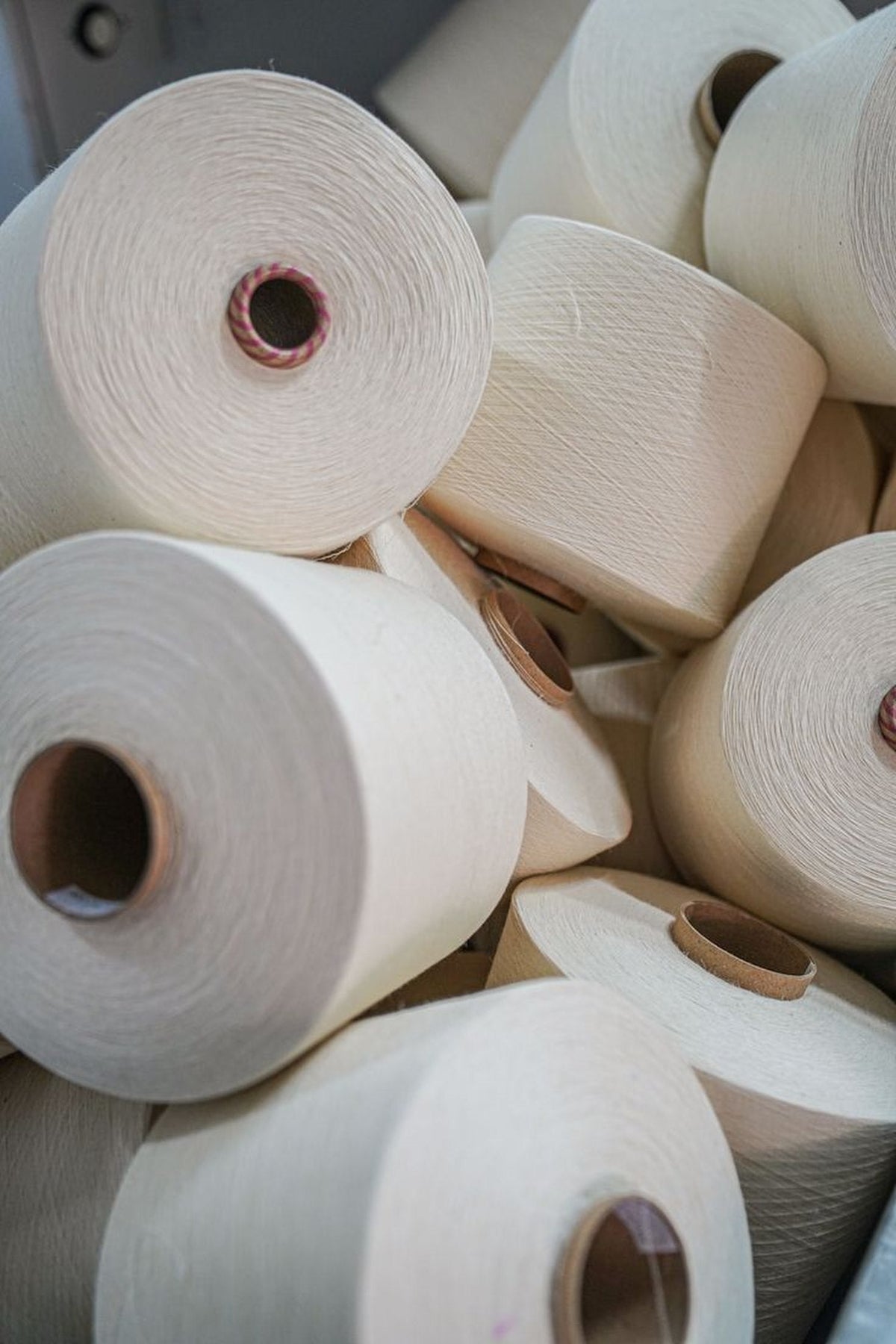
Nothing downstream can fix a bad yarn. Fibre type determines breathability and drape. Staple length — how long the individual fibres are — determines how much it will pill. Twist determines strength and surface smoothness. Ply determines weight and how evenly the colour reads.
We knit in two compositions: 100% cotton, and GRS certified 60% recycled cotton with 40% recycled acrylic. Keeping the palette narrow means we understand exactly how each behaves on the machine and on the body, rather than guessing across a dozen different yarns.


2. Setting the gauge
Stitches per inch — the most consequential number
Gauge is how many stitches the machine puts into an inch of fabric. A fine gauge of 12 to 18 stitches per inch produces smooth, light fabric close to a jersey T-shirt. A chunky gauge of 3 to 7 produces thick, sculptural, insulating fabric.
Gauge is not just a look. It decides warmth, weight, how much the fabric stretches, how it recovers, and whether the piece is wearable in 30°C. Fine gauge is what makes year-round knitwear possible at all — the loops are small and tight enough to hang cleanly, but the structure still lets air move through.
It also constrains the yarn. Fine gauge needs yarn strong enough not to break under machine tension, which is why the recycled blend contains a strengthening fibre rather than being recycled cotton alone.
3. Knitting the panels
Where fabric and shape happen together
This is the part that surprises people. The machine does not knit a large sheet that then gets cut to shape. It knits each panel — front, back, sleeves — already in its final shape, by adding or dropping stitches across rows to widen and narrow the piece.
An armhole curve is knitted as a curve. A shoulder slope is knitted as a slope. Because nothing is cut, there are no raw edges, almost no offcut waste, and the loop structure runs uninterrupted to the very edge of the panel. That continuous structure is why a well-made knit keeps its shape: there is no cut edge waiting to unravel or stretch out.


4. Linking the panels
The step most brands skip
Linking joins two knitted panels stitch by stitch. Each loop on one edge is matched to the corresponding loop on the other, and the two are joined as a knitted row rather than sewn with thread.
The result is a join that behaves like the fabric around it. It stretches when the fabric stretches. It lies flat instead of forming a ridge. It does not restrict the shoulder or dig into the underarm.
The alternative is overlocking — running the two edges through a sewing machine, which is faster and considerably cheaper. An overlocked seam is a line of thread through knitted fabric. It has different stretch from the fabric, so under repeated wear the seam and fabric fight each other. That is why cheaper knits ripple at the shoulder seam or feel tight across the back when you reach forward.
You can check this on any knit you own. Turn it inside out and look at the shoulder seam. A flat, smooth join that looks knitted is linked. A raised, thready ridge is overlocked.
5. Washing, finishing and pressing
Where the garment settles into itself
A knit comes off the machine slightly tense. Washing relaxes the loops into their natural position, and the piece is then dried flat and pressed to its final measurements.
Skipping or rushing this stage is one reason some knits change size noticeably on their first home wash.
Why small batches
| Aspect | Small batch | Mass production |
|---|---|---|
| Yarn choice | Chosen per style; cost is a smaller share of the decision. | Chosen by price per kilo across thousands of units. |
| Seams | Linked, which takes real time per garment. | Usually overlocked for speed. |
| Checking | Every piece handled individually. | Sample-based quality control. |
| Overproduction | Limited. Batches are kept small. | Structural, and the reason for heavy discounting. |
Every piece we make is knitted in small batches, in 100% cotton or GRS certified 60% recycled cotton, 40% recycled acrylic, with linked seams. It is slower and it costs more per garment. It is also the difference between a knit that holds its shape for years and one that sags at the elbows by the second season.
What to look for in any knit
None of this is proprietary. Use it on anything you are considering buying, from us or anyone else.
- Turn it inside out and find the shoulder seam. Flat and knitted-looking means linked. A thread ridge means overlocked.
- Read the fibre ratio, not just the names. A natural fibre in the majority will breathe. A fully synthetic composition will not.
- Stretch the cuff and let go. It should return. If it stays stretched, the rib is under-tensioned and the whole garment will follow.
- Hold it up to the light. Even, regular stitches mean consistent tension. Irregular ones mean a rushed run.
- Look at the armhole. A knitted curve sits smooth. A cut-and-sewn armhole often puckers.
Frequently asked questions
How is knitwear made?
Knitwear is made by knitting yarn into interlocking loops on a knitting machine. Each panel of the garment is knitted to its final shape by adding and dropping stitches, rather than being cut from a sheet of fabric. The panels are then joined, ideally by linking, and the garment is washed and pressed to its final measurements.
What is linking in knitwear?
Linking joins two knitted panels stitch by stitch, matching each loop on one edge to its counterpart on the other. It creates a seam that stretches with the fabric and lies flat, unlike an overlocked seam, which is a line of thread with different stretch from the knit around it.
What is the difference between linked and overlocked seams?
A linked seam is knitted, so it has the same stretch as the fabric and lies flat against the body. An overlocked seam is sewn with thread and forms a small ridge, and because it stretches differently from the knit it can cause rippling or tightness over time. Linking is slower and more expensive, which is why it is mostly found on better knitwear.
What does gauge mean in knitwear?
Gauge is the number of stitches per inch of fabric. Fine gauge, around 12 to 18 stitches per inch, produces light smooth fabric suitable for warm weather. Chunky gauge, around 3 to 7, produces thick insulating fabric for cold weather. Gauge determines warmth, weight, stretch and drape.
Why is knitwear more expensive than woven clothing?
Knitting creates the fabric and the garment shape at the same time, so machine time per piece is much longer than cutting panels from ready-made cloth. Finishing steps like linking are done stitch by stitch. Yarn is also a larger share of the cost than woven fabric typically is.
Is knitwear cut and sewn?
Well-made knitwear is not. Each panel is knitted to shape, so there are no cut edges and very little waste. Cheaper knitwear is sometimes cut from knitted yardage like woven fabric, which creates raw edges that need overlocking and tends to lose shape faster.
What does small batch production mean?
It means producing a limited number of units per style rather than large runs made far in advance. It allows individual handling of each garment and more considered material choices, and it reduces the overproduction that leads to heavy end-of-season discounting.
Why this matters when you buy
Almost none of this is visible on a rail. Two knits can look identical and wear completely differently, because the differences are in the yarn, the gauge and the seams. Knowing what to look for is the only real protection against paying for something that will not last.
See what we make in the knitwear collection, or read more on the yarn we use and why knits pill.
Read more
What Is Recycled Cotton-Acrylic, and Why We Knit With It
Recycled cotton is too weak to knit on its own — which is why the 60/40 ratio is a technical decision, not a cost one. What the material is, what GRS verifies, and the trade-offs.
Read more
How to Wash Knitwear Without Ruining It
Heat, agitation and gravity are what ruin knitwear — not washing itself. The full method for machine and hand washing, drying, and rescuing a knit that's already gone wrong.
Read more

